You're offline - showing saved content

The rules of the road

Bike like you live here

The laws, the hand signals and the unwritten etiquette - everything visitors need, in ten minutes.

The quick cheat sheet

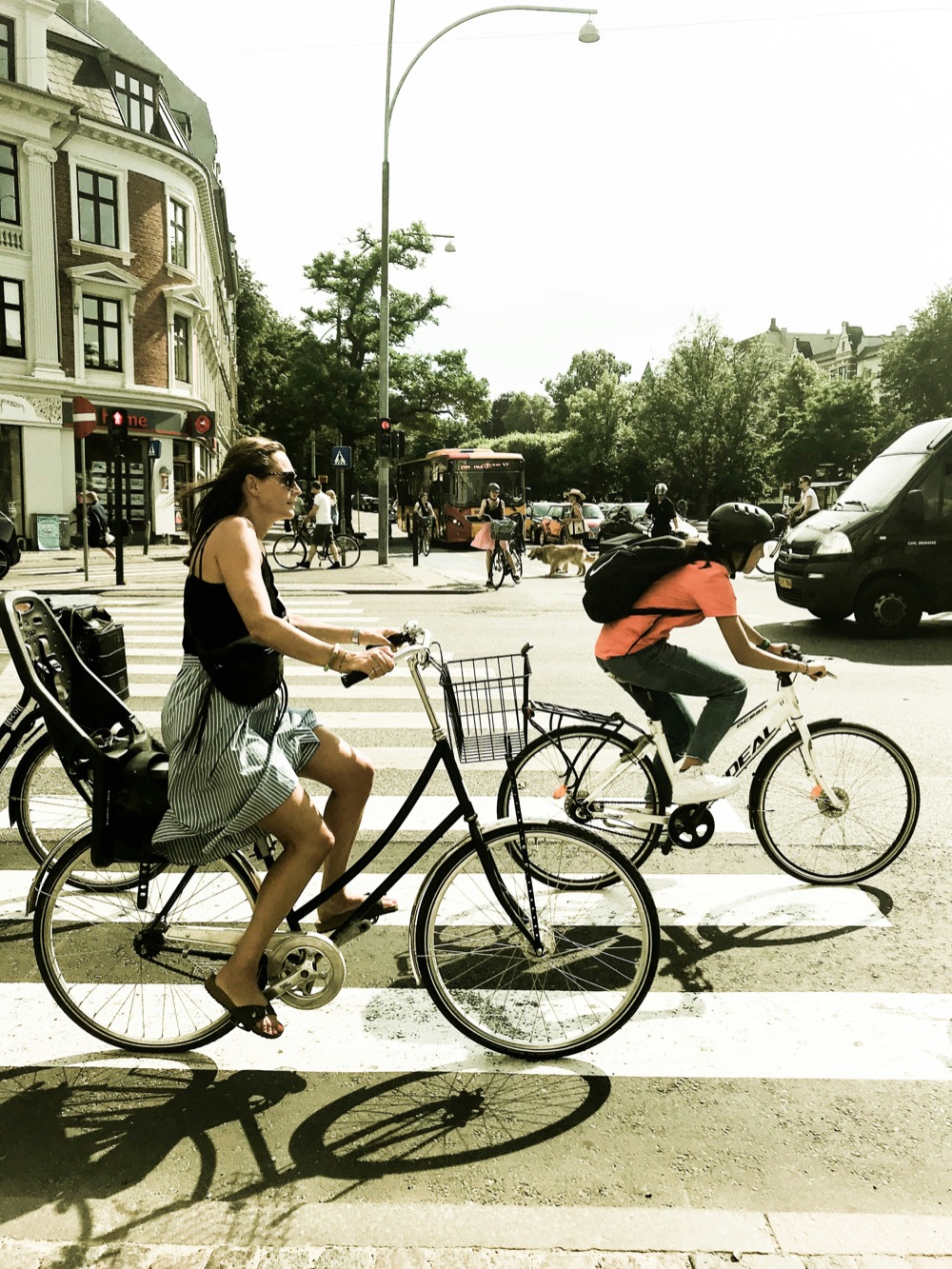
Cyclists with a child seat waiting at a Copenhagen crosswalk

Legal

Ride in the bike lane - always

Where there is a cycle track (the raised lane between the pavement and the road), you must use it - riding on the sidewalk or in the car lane is illegal and fined. Always ride with the traffic, never against it.

Copenhagen has nearly 400 km of separated cycle tracks, so this rule works in your favour: you almost always have your own protected lane.

Lights on after dark

From dusk to dawn you must have a white light at the front and a red light at the rear, visible from 300 metres. Police enforce this actively, especially in autumn - expect a fine of around 700 kr per missing light.

Rental bikes normally come with lights fitted; check they work before you ride off, and that includes share bikes.

Keep your phone in your pocket

Using a handheld phone while cycling is illegal in Denmark and fined around 1,000 kr. That includes texting at red lights.

If you need the map, do what locals do: pull over to the right, out of the lane, and check it standing still. A handlebar mount is legal.

Helmets: optional, but smart

There is no helmet law in Denmark for any age - you will see plenty of bare heads. That said, most rental shops offer helmets for around 50 kr/day, and we recommend one, especially if you are not used to riding in city traffic.

One bike, one person

Passengers on the luggage rack are illegal, however charming it looks in films. Children may only be carried in an approved child seat or a cargo bike - which is exactly why Copenhagen is full of cargo bikes.

Renting a cargo bike or a bike with a child seat is easy; several shops in our rental guide offer both.

Cycling under the influence

There is no fixed alcohol limit for cyclists in Denmark, but police can and do fine riders who are visibly unable to ride safely - typically around 1,500 kr. After a long evening, walk the bike or take the night bus; bikes ride free on the S-train.

One-way streets and pedestrian zones

One-way signs apply to bikes too, unless a small "cykler undtaget" (cyclists excepted) sign says otherwise - many Copenhagen one-ways have it. Pedestrian streets like Strøget are walking-only during shopping hours: dismount and push the bike.

Children on bikes

Children under 6 may only cycle on the road when accompanied by someone aged 15 or older. Young children are normally carried in cargo bikes or child seats instead - and unlike adults, kids will get a free pass from no one if their bike lacks lights and reflectors, so check the equipment.

Signals

Learn the two hand signals

Copenhagen traffic runs on two signals: an arm stretched out to the side means "I'm turning that way"; a hand raised straight up means "I'm stopping". Use them every time - the rider behind you is closer than you think.

Signal before you brake, not as you brake, and make it visible. It is the language every Copenhagen cyclist speaks.

Right on red - only when the sign says so

At some intersections a small blue sign with a green arrow allows cyclists to turn right on red after yielding. No sign, no turn - running a red light costs around 1,000 kr, and cameras and police both watch the big crossings.

Intersections

The Copenhagen left turn

Cyclists never turn left like cars. Instead: ride straight across the intersection, pull in at the far corner, re-orient your bike in the new direction, and ride on when that light turns green. It is called the "Copenhagen left" (a box turn), and it is mandatory.

Cutting diagonally across an intersection is both illegal and the easiest way to end up in front of a car.

Stay out of truck blind spots

The most serious cycling accidents in Copenhagen involve trucks turning right across the bike lane. Never wait beside a truck or bus at a red light - hold back or move clearly in front where the driver can see you.

If a truck has its right indicator on, assume the driver cannot see you. A few seconds of patience is the best safety gear in this city.

Crossing on blue: cycle crossings

The blue-painted lanes through big intersections mark where cyclists ride - follow them and keep your line steady. Cars legally cross these lanes when turning, so make eye contact with drivers and never assume you have been seen, even when you have right of way.

Stop for bus passengers

When a bus stops where passengers step directly onto the cycle track, you must stop and let them cross - it is the law, and locals take it seriously. Watch for the bus doors: if they are open or opening, brake.

Etiquette

Keep right, overtake left

The bike lane works like a road: slower riders keep right, faster riders pass on the left. Never overtake on the right, and check over your left shoulder before you pull out - someone is probably already passing you.

Riding two abreast is legal when it does not block others, but at rush hour, single file is the polite default.

The bell is a heads-up, not an insult

A short ring means "I'm here, I'm passing" - it is a courtesy, not road rage. Ring early when overtaking, and if someone rings at you, just keep your line or ease right. No offence is meant and none should be taken.

Never stop in the bike lane

The cycle track is moving traffic - stopping in it to check a map or take a photo is the fastest way to cause a pile-up and hear some Danish words you won't find in the phrasebook. Signal, pull off to the right onto the sidewalk edge, and stop there.

The same goes for getting on and off: mount and dismount at the edge, not mid-lane.

Rush hour is real traffic

Between 7:30-9:00 and 15:30-17:30 the cycle tracks carry tens of thousands of commuters moving fast and predictably. If you are sightseeing, consider riding outside these windows - or keep right, signal clearly and treat it like merging onto a highway, because that is what it is.

Park like a local

Park in bike racks or along walls, never blocking sidewalks, doorways, metro entrances or other bikes - badly parked bikes get moved or removed. Use the wheel lock (standard on Danish bikes), take nothing valuable, and note where you parked: a thousand black bikes look alike at midnight.